
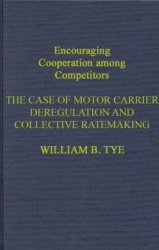

Collective ratemaking in the motor carrier industry is undoubtedly one of the most poorly understood issues in the literature on economic regulation. While strongly held opinions are commonplace, real knowledge of the collective ratemaking process and of how trucking tariffs are constructed is scarce.
William Tye closes this gap in our knowledge with the most comprehensive study yet of the effects of the Motor Carrier Act of 1980 on competition on the trucking industry. Review: ?Tye, a principal of a consulting firm in Boston, has studied what economists often ignore: the facts and institutions of a market.
Based on economic evidence in the trucking industry under post-1980 deregulation (numbers of firms and truckers, entry and exit of firms, independent action on price setting, and the flexibility of prices), the author concludes that collective rate making through rate bureaus' is an efficient way of organizing the market, not a method of controlling price(s) in a collusive manner. . . .
This study supports the basic and complementary economic propositions that for monopoly power to exist there must be control over supply (entry), and even collective price leadership (and list prices) may be barometic (vice collusive) and not price fixing' of the sort condemned by antitrust laws. This study is differentiated from other trucking studies (often in journal articles) by its attention to the facts of the industry. . . .
The audience is wide, including undergraduates with only a smattering of economics, as well as policymakers, lawyers, and interested citizens.?-Choice
 Related Products
Loading similar products...




Stay informed about the best deals and price drops. Choose which notifications you'd like to receive from PriceCheck.

Free easy-to-follow course for anyone in South Africa who wants to learn how to start a digital business.

