Sign in with Google
Or, sign in using email/password
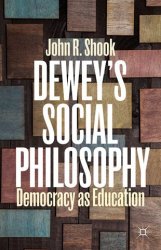

Dewey advanced a political vision for democracy as a form of deliberative polyarchy grounded in community ethics. This vision depicts citizens engaged in communal exercises in experimental civic education. This ethical project, to successfully pervade all of democratic society must be revolutionarily comprehensive.
Maintaining the civil peace, a productive economy, a participatory citizenry, an effective penal system, and a religiously harmonious society are top democratic priorities. The economy needs employees and entrepreneurs who are more broadly educated, not merely well-trained; education is so crucial for empowerment that it must be a civic guarantee; education should be prioritized in law and criminal justice; and education is crucial for ethical communities embracing religious pluralism.
Dewey's core views on humanity's capacities for learning, socializing, problem-solving, self-ruling, and flourishing forge a whole far greater than its parts. His progressive revolution is yet to be realized, but his philosophy remains just as insightful and relevant as ever. Review: This is a profound meditation on the most intimate connections between democracy and education.
Taking his cue from John Dewey's masterwork Democracy and Education, Shook encourages his readers to consider how a vital educational agenda can foster reconstruction of the norms of justice, moral behavior, and religious belief in a time of debilitating economic and racial divisions. - Larry A. Hickman, Center for Dewey Studies, Southern Illinois University, USA In this elegantly written and masterfully researched book, a leading contemporary pragmatist investigates how John Dewey saw education as the 'fundamental engine of democracy.' John Shook discusses Dewey's faith in the moral and ideal nature of democracy as a cooperative and communal educational venture.
Democratic commitments go beyond education as simply schooling for Dewey. In a particularly brilliant chapter, Shook demonstrates how Dewey's democratic humanism, as the clear consciousness of a moral life, forms a powerful educational argument about the role of punishment in a democracy. Impassioned agents in the emerging democracies around the world can learn much from a book that describes education as far beyond simple information acquisition and even skill development but rather more a cooperative shared development of a capacity for intelligent problem-solving.
I recommend this book highly as a major accomplishment in Dewey scholarship and will assign it in my graduate classes. - AG Rud, Distinguished Professor, College of Education, Washington State University, USA
 Related Products
Loading similar products...

Stay informed about the best deals and price drops. Choose which notifications you'd like to receive from PriceCheck.

Free easy-to-follow course for anyone in South Africa who wants to learn how to start a digital business.