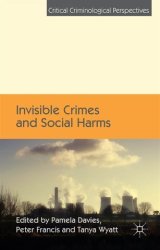

Why does so much crime and victimisation remain invisible and what can be done about it? This is the central tenet of Invisible Crimes and Social Harms, a ground-breaking new collection of chapters, in the Palgrave Macmillan series Critical Criminological Perspectives. Invisible Crimes and Social Harms explores the reasons for the continuing invisibility of much crime and harm and the lack of adequate response, explains how various injustices have become more visible or rendered less so over time and place, and explores what can be done to connect the intellectual with the search for social justice and social policy.
Within its pages, this compelling volume explores the various 'spaces' of invisibility - the body, home, street, environment, institution and the state- through a wide range of fascinating case studies and examples, to develop a radical criminological framework of typological underpinnings applicable to a range of crimes and harms that tend to remain obscured or hidden.
This book is an essential resource for lecturers, researchers, students and practitioners of criminology and criminal justice, as well as for everyone interested in debates about crime, harm and social justice. Review: The idea that, if we are to properly understand crime, we have to be prepared to look well beyond official statutes, penal codes and conventional definitions belongs to what is perhaps the most stimulating tradition in criminological analysis.
Edwin Sutherland, conflict theorists and abolitionists are outstanding representatives of this tradition, which finds energetic and innovative following in this remarkable collection. A wide range of conducts is addressed, from sexual crimes to environmental damage, from elder abuse to bio-piracy, from health and safety violations to fraud: all invisible crimes causing very visible social harm. - Vincenzo Ruggiero, Middlesex University, UK 'In a world characterized for decades by a relentless harshness toward many kinds of crime, some of the most harmful and destructive actions by corporations, governments, and individuals have largely escaped punishment-or even recognition as crimes.
Why this should be so, and the consequences of this neglect and 'invisibility' for human well-being and social justice, is the subject of this thoughtful, wide-ranging, and stimulating collection. Invisible Crimes and Social Harms makes a compelling case for moving beyond criminology's conventional boundaries to redefine both what we study and how we study it.' - Elliott Curry Professor of Criminology, Law and Society at University of California, Irvine.
 Related Products
Loading similar products...

Stay informed about the best deals and price drops. Choose which notifications you'd like to receive from PriceCheck.


