Sign in with Google
Or, sign in using email/password
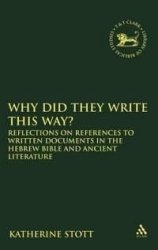
This book examines the character and function of the documents mentioned in the biblical texts in relation to comparable references in literature from wider antiquity. Citing various references to written documents in the Hebrew Bible, Stott takes into consideration both those references that may point to external sources, for example, the many literary citations in the books of Kings and Chronicles, as well as certain other documents that play a role in the narrative, such as the book of the law in 2 Kings, the scrolls of Jeremiah, and the tablets of the law.
The aim of this study is not to determine to which texts external to the world of the narrative, if any, these documents refer, or to identify the content of these documents, or to reconstruct their origins and historical development. Instead, the primary focus is to understand these references within their literary context, asking why indeed they are mentioned at all and what purpose they serve in the narrative, regardless of whether they existed or not in the external world, or whether the stories about them have basis in historical reality as it happened.
Review: 'The first section focuses on references to so-called external texts such as 'the book of the kings of Israel'. Stott does not seek to establish whether these texts actually existd. Instead she examines the literary value of citation, why are they cited and what literary purposes the citation serves.
She uses similar Graeco-Roman texts as a foil to bring out the literary devices being employed. The second section provides a detailed discussion of the rhetorical value of the strou of the discorvery of the 'Book of the Law' in 2 Kings 22-23 and other examples of the use of texts as the subject of narrative in the Hebrew Bible.
The monograph provides a balanced and thought-provoking discussion of how text is treated in the Hebrew Bible. As she restricts herself to the Hebrew Bible, Stott only hints that a Greek literary milieu had a greater influence on Greek biblical texts' use of citations as seen in late additions to the alpha-text of Esther.
Her selection of comparison texts is also limited. The book is thus not exhaustive, but a helpful springboard to further exploration.' - John Starr, School of Divinity, University of Edinburgh, UK, in the Expository Times. --,
 Related Products
Loading similar products...

Stay informed about the best deals and price drops. Choose which notifications you'd like to receive from PriceCheck.

Free easy-to-follow course for anyone in South Africa who wants to learn how to start a digital business.