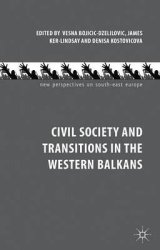
| Manufacturer | Palgrave Macmillan |
This book examines the ambiguous role played by civil society in state-building, democratisation and post-conflict reconstruction in the Western Balkans. In doing so, it challenges the received wisdom that civil society is always a force for good. Civil society actors have helped create the conditions for new, more constructive relations inside and between former Yugoslav countries.
But, their agency has also rekindled nationalism hindering efforts to rebuild the region after the conflicts of the 1990s. The book demonstrates that diverse civil society effects cannot be captured without querying both the nature of civil society and the complexity of the ongoing transformation. So how can the emancipatory role of civil society be harnessed?
This rigorous case study-driven reappraisal of the ability of civil society to support progressive transformation from an illiberal regime to democracy and from conflict to peace will be a valuable resource to scholars and practitioners alike. Review: 'This fascinating collection of essays on civil society and war- to -peace transitions in the Western Balkans is a must read.
Anyone who is sensitive to the dilemmas currently facing those actors, from the local to the global, involved in peacebuilding or statebuilding will recognise them too. This volume places civility, society and the pressing question of what emancipation actually means in liberal modernity back at the centre of the debate on peace in the region, the function of the state, and the role of international actors.' Oliver Richmond, Humanitarian and Conflict Response Institute and Department of Politics, University of Manchester, UK 'This thoughtful volume offers an important contribution to scholarship on the role which civil society plays in post-conflict societies.
The contributions rightly challenge the frequent presumption that civil society actors necessarily promote civility, human rights, or democratisation. The nuanced studies of experiences from the Western Balkans demonstrate the range of civil society, with its virtues and vices, offering cautionary tales for international policymakers and programmers who seek to promote civil society often without understanding the pitfalls.
Chandra Lekha Sriram, School of Law, School of Oriental and African Studies, University of London, UK 'This book offers wonderful insight and systematic reflection on the paradox of civil society in Eastern Europe, which after returning the concept to both the headlines and the academic curricula in 1989 has found far more difficult since to deliver the promised liberal democracy ideal.
A must read for activists, donors and everyone interested in the process of building democratic constituencies everywhere.' Alina-Mungiu-Pippidi, European Research Centre for Anti-Corruption and State-Building, Hertie School of Governance, Germany
 Related Products
Loading similar products...

Stay informed about the best deals and price drops. Choose which notifications you'd like to receive from PriceCheck.


