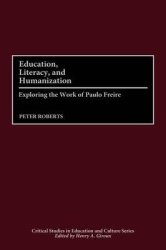

The author adopts a holistic approach in exploring the ontological, epistemological, ethical, and pedagogical dimensions of Paulo Freire's thought. The book discusses Freire's approach to adult literacy education and investigates the political, dialogical, and critical aspects to the multidimensional word in Freirean theory.
The author outlines and assesses a number of key critiques of Freire's modernism, concentrating in particular on questions pertaining to the problem of pedagogical intervention. He responds at some length to C.A. Bowers, one of Freire's most important and persistent critics, and finds fault with behaviorist, stage-based accounts of consciousness raising.
The Freirean concept of conscientization is reinterpreted in light of the postmodern notion of multiple subjectivities. From this book, Freire emerges as a complex educational figure: a thinker and teacher deeply committed to the universalist ideal of humanization, yet also wary of some of the exaggerated certainties of modernism.
His work, for all its flaws and contradictions, remains highly influential and stands opposed to technicist and neoliberal tendencies in recent educational reform initiatives. Review: .,. .Teacher educators and educational philosophers can learn much from the book; so too can qualitative researchers, for Roberts's explanation vividly reveals the qualitative character of Freire's thinking.
Roberts promises another book that will apply Freire's ideas to debates about curriculum reform, political correctness, and higher education--something to look forward to! Upper-division undergraduates, graduate students, faculty, and practitioners. -Choice
Kindly note that PriceCheck is a discovery and comparison platform.
Unfortunately, we are not able to give intensive advice or reviews as we do not stock the product.
 Related Products
Loading similar products...

Stay informed about the best deals and price drops. Choose which notifications you'd like to receive from PriceCheck.


