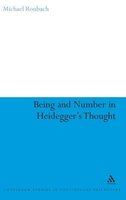
Being and Number in Heidegger's Thought examines the relationship between mathematics and ontology in Heidegger's thought, from his earliest writings, through Being and Time , up to and including his work of the 1930s. The book charts the unfamiliar territory of Heidegger's conception of mathematics, and explores the relationship between time and number in/Heidegger's magnum opus, Being and Time .
Michael Roubach offers a new analysis of Heideggerian finitude, one of the most recalcitrant problems in the interpretation on Being and Time . In addition, he situates Heidegger's thought with respect to some of the core debates in logic and the foundations of mathematics.The book goes on to elucidate Heidegger's reading of mathematics as ontology in his writings from the 1930s.
Roubach argues that exploring the connection between mathematics and ontology in Heidegger's thought affords us new insight into the origins and evolution of Heidegger's radically original take on the traditional problems of philosophy.This facilitates a reassessment, not only of specific issues in Heideggerian thought, but also of the larger question of Heidegger's place in twentieth-century philosophy.
Review: Mention -Chronicle of Higher Education, May 30, 2008 Mention --Chronicle of Higher Education, May 30, 2008 Mention Chronicle of Higher Education, May 30, 2008 One reason to welcome a book on Heidegger on mathematics is that it should help retire a pair of stale falsehoods: that Heidegger's philosophy, and so-called continental philosophy more broadly, is inimical to rationality, science, logic, and mathematics; and that commentators on Heidegger revel in and propagate such a rift.
Unfortunately Roubach's book has only mixed success in undermining the second of these...Roubach's book has other faults. His arguments occasionally confuse Heidegger's reports of other people's views with his own...Roubach makes intriguing suggestions about the influence of Cantor's, Dedekind's and Brouwer's work on Heidegger...But Roubach's book does not do enough to illuminate these connections, and it generally misconstrues their place in Heidegger's overall ontology. - Stephan Kaufer, Notre Dame Philosophical Reviews, September 20, 2008--Sanford Lakoff Notre Dame Philosophical Reviews





 Related Products
