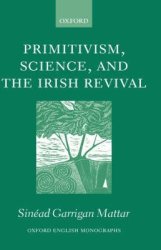

The literature of the Irish Revival of the 1890s should be seen as a hinge between the nineteenth- and twentieth-centuries. Its authors appropriated the 'primitive' through the lenses of comparative anthropology, mythology and colonial travel-writing and actively strove to re-establish contact with primitive modes through 'the study of mythology, anthropology and psychoanalysis'.
They were engaged in was a complex and volitional primitivism, which became 'modernist' as it utilized the findings of social science. The works of W. B. Yeats, J. M. Synge and Lady Gregory are all analysed as the product of such influences. But Garrigan Mattar also suggests that Celticism itself underwent a sea-change during the nineteenth century, recreating itself in academic circles as an anti-primitivist science - 'Celtology'.
It was only to be a matter of time before Yeats and Synge, who read widely in the works of Celtology, would look to this new science to find alternatives to the primitivism of the Twilight. Review: This forceful and engaging book will oblige significant revision of established critical views of Yeats, Synge, and Gregory.
James Pethica, Modernism/Modernity Mattar shows how Yeats, Synge and Gregory variously construed anthropologists' changing ideas of the primitive ... One reason why Yeats and Synge got into trouble was because Irish nationalism retained self-boosting and Christianized noble savage concepts, whereas they had absorbed comparative anthropology's tilt towards darker gods.
This more interesting, problematic and disturbing brand of primitivism, Mattar suggests, underlies the ritualistic forms they introduced to the Irish theatre - whether to awaken the audience or the gods. Mattar's book exemplifies the value of questioning both the Revival's self-projections and powerful academic paradigms.
Edna Longley, The Dublin Review
 Related Products
Loading similar products...

Stay informed about the best deals and price drops. Choose which notifications you'd like to receive from PriceCheck.


