
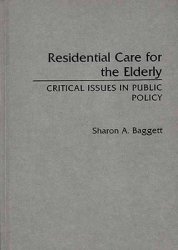

Although residential care and assisted living for older adults has expanded rapidly in recent decades, it has done so in a policy environment beset by confusion and conflicting purposes. Sharon A. Baggett traces many of the current problems to insufficient knowledge of the population these policies are designed to serve.
In her examination of the frequently neglected interface between policy and people, she provides a comprehensive review of current federal and state policies, a detailed case study of a state residential care program, and an analysis of the needs and characteristics of persons in assisted living facilities.
Baggett's policy overview covers such areas as the confusion between housing and care, supply and demand factors in the economics of residential care, conditions contributing to the increase in numbers of assisted living facilities, and current policies that define and limit the choice of residential alternatives.
A case study of Oregon's residential care program shows how that state has adapted federal initiatives to local goals and philosophies of long-term care. Funding mechanisms, regulations, and the role of state agencies in developing and monitoring compliance are discussed. Following a comprehensive profile of facility residents, the question of using functional assessment measures to determine individual needs is explored.
Linking the larger policy issues with an in-depth analysis of residents served and actual services provided, this book will be helpful to policy planners and developers, administrators, and case managers, as well as students and academics concerned with housing and assisted living services for the elderly.
Review: ?Baggett analyzes the growth of residential care facilities (RCF) for the aged and the characteristics of residents from a public policy framework. Baggett begins with an excellent review of literature tracing both the conceptual and the historical development of RCFs, arguing that this is a service system based on the notion of age-related deterioration.
Baggett then analyzes demand characteristics, including population shifts, health care costs, and utilization and long-term care needs. She reviews factors affecting the supply of residential facilities, including structure of the industry, cost, technology, and financing. Both generally and specifically in Oregon Baggett examines the impact on RCFs of state and federal regulatory policies, particularly the Keys Amendment.
In the last two chapters she suggests future changes in structure, programs, and regulation that will affect the RCF industry. Aside from congressional hearings, little previous work has been done in this area. The study includes end-of-book references and index, few tables, and is written in a very straightforward and readable style.
Recommended for libraries supporting programs in gerontology.?-Choice
 Related Products
Loading similar products...




Stay informed about the best deals and price drops. Choose which notifications you'd like to receive from PriceCheck.

Free easy-to-follow course for anyone in South Africa who wants to learn how to start a digital business.

